
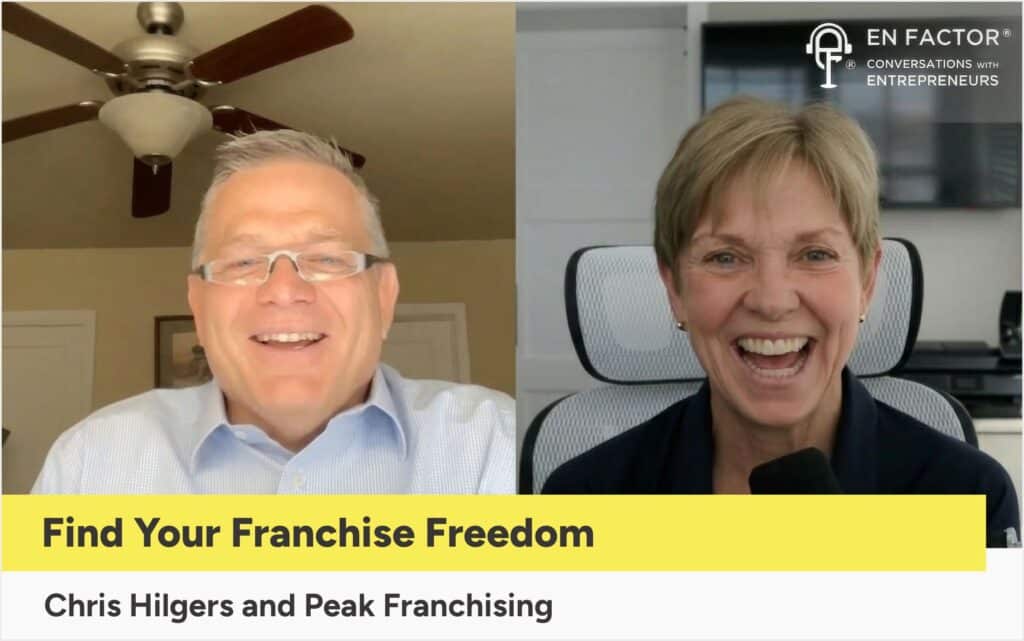
I recently had the pleasure of welcoming Chris Hilgers to the En Factor podcast. Chris is the founder and principal owner of Peak Franchising, and this conversation filled a gap I’ve been wanting to address for a while now.
We don’t talk enough about franchising in the entrepreneurship world.
Chris’s journey caught my attention immediately. He started in sales, grew up in family businesses, studied German in college, and spent 21 years in the corporate world before making the leap to entrepreneurship. His experiences gave him a front-row seat to how brands scale and what makes business platforms work.
The Real Education Happens Before You Know It’s Education
Chris shared something I hear often from entrepreneurs who grew up in family businesses. He didn’t realize at the time what an education he was getting just by being there.
He watched what it took to turn the lights on every day. He saw that not every day was going to be easy. He learned to push a broom and hold a flashlight and understand that a lot of things need to work for a business to succeed.
This matters more than people think.
When Chris was younger and working with business owners, he already had that foundational understanding. He knew what it took to be in business. That gave him credibility and perspective that you can’t get from a textbook.
My own experience mirrors this. My mom was a florist, and I learned early that when somebody died, we couldn’t go on vacation. We had to stay and do what needed to be done. You show up. You do the work. You figure it out.
That’s the real education.
What Chris Looks For in People (And What You Should Look For Too)
Chris’s tagline is helping high-quality people with high-quality franchising. So I asked him what he’s learned about identifying high-quality people.
His answer was simple but profound.
First, you need a vision or a dream. You can’t make somebody want to own a business. You can’t manufacture aspiration. Something has to trigger that from within.
When someone comes to Chris and asks “What do you have for me?” his first response is to flip it around. What are you looking for? What have you done to go after that so far? What are your drivers? What’s your why?
He’s looking for evidence. Not necessarily big things. Every day is part of the journey. He wants to see ideas and dreams, but more importantly, he wants to see actions and ambitions.
This resonated with me because I work with students who often say they don’t know what they’re passionate about.
You have to try things. You have to show you can do something, finish something, make an effort in some area.
The Franchising Misconception You Need to Understand
A lot of people think franchising is a safe and quick way to be an entrepreneur. A paint-by-numbers approach where someone else does the thinking.
Chris was clear about this from the start.
When you’re in franchising, you’re a business owner. Make no mistake about it.
It’s your business. You own it. The risk is real. The difference is that the risk is mitigated by having a proven business platform. Chris used a baseball metaphor that stuck with me: instead of starting at home plate in the batter’s box, you start at second base because the company has things in place that help you begin further along.
That doesn’t mean there’s no work. There’s a lot of work.
But you’re following a pattern that’s been validated. You’re leveraging a competitive advantage that’s already been built. You’re the owner of that business in your local area. The franchisor owns the brand overall.
People also tend to think about franchising in narrow terms. Food service. Hospitality. The traditional categories. But there are 4,000 franchise companies out there covering many different types of businesses. The key is finding something that works with your skill set and what you’re after.
How Chris Actually Helps People (And Why It Matters)
I wanted to understand how Chris positions himself as the right person to help someone navigate their franchise journey. His answer revealed something important about how real coaching works.
First and foremost, it’s about communication. He can have all the knowledge and experience in the world, but if he can’t communicate who he is as a person, none of that matters.
He’s not selling franchises. He’s helping people.
This requires listening more than speaking. Understanding why you’re having the conversation in the first place. Getting a feel for your background and where you’re coming from.
Chris ran Toro’s international consumer business, which meant everything outside the United States. The first thing he had to do was understand cultures, how they negotiate, what they’re looking for. He applies that same approach to every individual he works with now.
What’s your story been? What is it now? What do you want it to be?
If he’s listening on that front, if he’s hearing why you’re having this conversation in the first place, trust starts to build. Nobody wants to be sold. As a coach, Chris needs people to understand he’s not selling them anything. He just needs to understand who they are.
Then he builds from there.
He asks what you want life to look like. He might look at your resume and see you’ve been a president, a CEO, a board member with an incredible background. But the question remains: why are we talking in the first place? What are you looking for? What’s important to you?
This matters whether you’re early in your career, mid-career, or later. The approach is always about listening and understanding where you’re coming from first. Then building a personal model that helps send you in directions that make sense for you.
Money, Time, and What People Actually Want
I asked Chris about the most common goals he sees when people come to him about franchising.
Yes, it’s about money. Return on investment. People have been working for a long time to build something, and they’re looking to grow that.
But the second thing is time.
Many people are in the corporate world and they don’t own their own schedule. They’re looking for relief from a time perspective. This is one of the main drivers.
Here’s where it gets tricky. Some businesses do take a lot of time. You need to be aware of that. You need to understand what your role is as the owner and what the expectations are. Is it a 10 to 20 hour a week requirement? Is it 50 hours a week?
Chris covers this early in the process because it matters.
I asked if people try to keep their corporate job while starting a franchise. His answer: yes and yes. Yes, they want to. Yes, it’s often a challenge.
There’s a risk factor. There’s fear of what’s next. People want to keep their job and often they can. But it depends on you and how you manage your business, your job, your career.
The way to validate this is by talking to other franchisees during the process. Get a feel for what they’re doing, where they came from, what their background was. Some people make the leap with help on the way out. Others have saved money to live on and need to understand how fast the business will scale.
Chris looks at different paths with people so they’re not just going down one route. They can check the boxes and feel confident about their choice.
The Red Flags You Need to Watch For
I wanted to know what red flags someone should look for in a franchise agreement or company.
Chris’s answer was immediate and clear.
The most important thing is validation.
What do franchisees within the system say about the franchise company? People are pretty transparent. The franchise agreement includes 100% of the franchise owners’ names, numbers, and contact information. This is required by the Federal Trade Commission. Every year companies get re-registered and they have to include this in the franchise disclosure document.
You learn about things when people tell you things specifically. You also learn about things when they don’t tell you things specifically.
The franchise disclosure document helps you understand numbers, costs, financial performance data. Because of the way franchise businesses are regulated by the Federal Trade Commission, they all follow a similar process. This means you can look at very different types of businesses and measure them against each other.
You can evaluate them even if you don’t have experience in those specific areas, as long as you have good business experience.
Chris also emphasized looking for companies that show proof they have the ability to build a business. When you get involved with a franchise that’s earlier in the process, there’s a learning curve. There are growing pains. You could be a big fish in a small pond, which could be good. But if you don’t have a lot of experience, that’s not the right path. If you’ve done it before, you know what to expect and how to pivot.
Vision, Pivots, and the Ability to Deal with Uncertainty
One theme kept coming up throughout our conversation: the power of vision.
Chris put it this way. You have to have a picture of where you’re going. It’s like driving down a road. You see where you’re going, you know where you’re going. You hit a bump, it moves you around a little, but you keep going in that direction.
If you don’t have a feeling of where you’re going, you hit a bump and you get thrown in the ditch. It’s hard to get out.
We all get thrown in the ditch at different times. The key is starting your business with a dream, with a vision of what you want life to look like. That’s first and foremost.
Chris hears from so many people who say they want to own their own business but don’t really know what it’s going to be. The same principle applies. You need to understand where you want to go with the business, where you’re going to take it.
For Chris personally, he wants to continue helping people and understanding people and helping them grow. He gets a big kick out of seeing people be successful. That drives him.
He also lives by something I found compelling: the quality of your life is your ability to deal with uncertainty.
This doesn’t mean you don’t care. It means you can’t zigzag all over the place. You have to keep going down the path while having a feel for the things that are going to potentially affect you. You’re reading the screen, reading the room, continuing to move forward.
Challenges are opportunities. When you run into those things, those are opportunities for you.
The Leap From Corporate to Entrepreneur
Chris spent 21 years in the corporate world before starting his own business. I asked him about that transition because it’s one many people face.
He had a very good path. It was defined as much as it could be (you never really know exactly where you’re going in the corporate world). But he looked at his life and realized that three to five years from then, he’d be dealing with the same stuff again. He’d be taking jobs that somebody else thought he should take because he was being groomed for certain things.
His identity was in the corporate world for 21 years. But he had to make some tough decisions about getting into franchising and starting from scratch, starting at zero.
Now he doesn’t look back. He appreciates that time, but he doesn’t look back. His focus is on new business opportunities, opportunities for his business and his family’s business.
His advice to anyone considering a similar move was simple and direct.
Understand what you want your life to look like. Don’t settle. Life is short. Go for it. Go for whatever it is that you want and realize you have more than what you’ve put out there so far.
Surrounding Yourself With the Right People
Near the end of our conversation, Chris brought up something I believe deeply: the importance of proximity.
Being around the right people and patterning yourself after people who’ve been successful matters. It’s okay to copy people, to follow somebody who’s been successful.
If you want to find somebody who wants to be negative, it’s easy to find. But you don’t want somebody to mislead you. You want to surround yourself with the right people.
Not only do you need to focus on others, but focus on identifying who you are and what you bring to the table. We need to understand what our path is and where we’re going.
What I Took Away From This Conversation
Franchising is not a shortcut. It’s business ownership with a proven platform that mitigates some risk and gives you a head start.
But you still have to do the work. You still have to have the vision. You still have to deal with uncertainty and pivot when needed.
The people who succeed in franchising are the same people who succeed in any business. They have a clear why. They show up. They validate before they commit. They surround themselves with the right people. They don’t settle.
Chris’s approach to coaching reinforced something I’ve learned over years of working with entrepreneurs and students: listening matters more than talking. Understanding someone’s story matters more than pitching solutions. Building trust matters more than closing deals.
If you’re considering franchising, I highly recommend you listen to the full episode with Chris. His insights go deeper than what I’ve captured here, and his experience speaks for itself.
You can connect with Chris and explore resources like his franchise investigation readiness survey and personal model plan here.
And if you’re standing at that crossroads between the corporate world and entrepreneurship, or between dreaming about business ownership and actually doing it, remember what Chris said.
Understand what you want your life to look like. Don’t settle. You have more potential than you’ve tapped into so far.
The question is whether you’re ready to go after it.
Note: A first draft of this article was written using AI.