
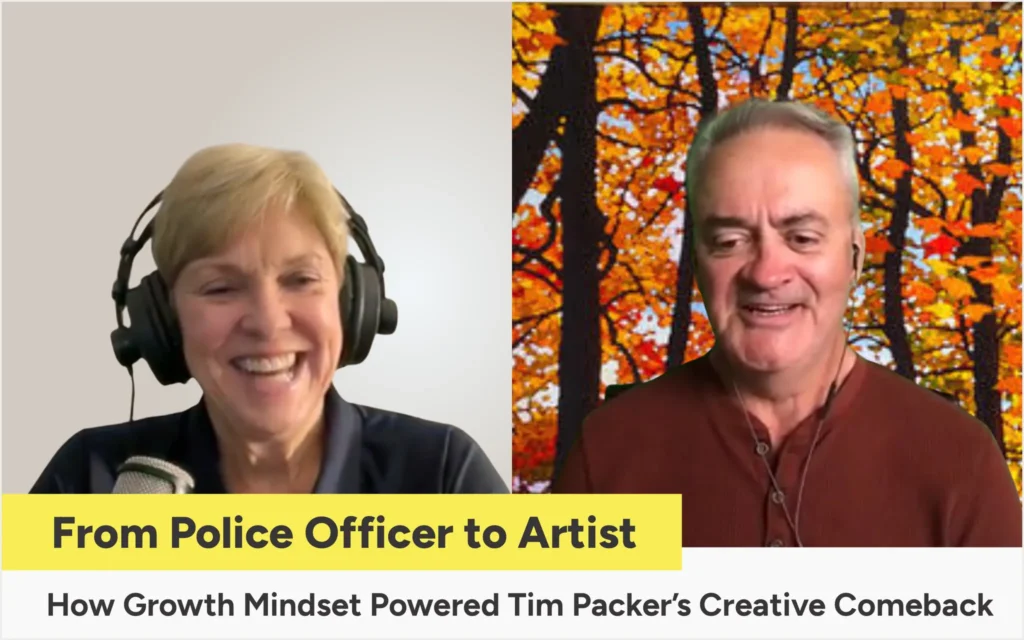
Tim Packer loved art as a young man. He wanted to build a life around it.
But like so many of us, he chose the “practical” path instead. He thought being an artist couldn’t support a family. So he became a graphic designer, then a police officer, then a detective in Toronto’s commercial crime unit.
The safe and responsible choice.
Except it almost cost him everything he actually wanted.
I recently spoke with Tim on the En Factor podcast, and his story reveals something I’ve seen across more than 175 conversations with entrepreneurs. The thing we think will protect us often becomes the cage we need to escape.
The Word That Changes Everything
In his thirties, Tim discovered something that shifted his entire trajectory. Growth mindset research.
The idea is simple but powerful. Talent isn’t fixed. It can be developed through dedication and practice.
Tim put it beautifully during our conversation. When people say “I can’t do something,” they need to add one word: yet.
That single syllable transforms everything. “I can’t paint” becomes “I can’t paint yet.” “I don’t know how to start a business” becomes “I don’t know how to start a business yet.”
Not natural talent. Not genius. Perseverance.
After losing a fellow officer in the line of duty, Tim was reminded that life is short. He decided to pursue art alongside his police work. He committed to painting three times a week. He focused on improving his weaknesses.
Within a year, he saw remarkable progress.
His wife eventually suggested he pursue art full-time. She recognized its financial potential before he did.
The “impractical” dream became the viable career. The “safe” job became the thing holding him back.
Entrepreneurship as Experiment
When I talk to students about entrepreneurship, I always tell them to think of every venture as an experiment.
You’re not predicting the future. You’re testing hypotheses, gathering data, and learning.
This reframe removes so much pressure. You don’t need to know everything before you start. You don’t need to have it all figured out.
You start with who you are, who you know, and what you know. Then you build from there.
Tim’s artistic journey proves this. Through experimentation and studying other artists’ techniques, he developed his distinctive style. The style that eventually resonated with audiences and led to commercial success.
But he couldn’t have designed that outcome in advance. He had to discover it through practice.
Mid-career pivots aren’t reckless. They’re normal and they work.
Building Resilience Through Repetition
One of the most common areas of resistance I see in aspiring entrepreneurs is fear. Fear that they’re not enough. Fear that they don’t know enough. Fear that they’ll fail.
Watching other successful people, we assume they knew what they were getting into. We think they had some special insight or preparation we lack.
The reality? Everybody has to learn along the way.
Nobody really knows what they’re getting into. Not at first. Not completely.
Resilience isn’t something you have. It’s something you build through repetition.
The first time you face a major setback, it feels devastating. But if you push through it, the next time gets easier. And the next time after that.
You start to recognize that setbacks aren’t fatal. They’re opportunities to change direction, to learn something, to move forward in a more productive way.
Tim experienced this firsthand. His own near-death experience prompted him to reflect on his legacy. Instead of seeing it as an ending, he saw it as a redirection. He shifted his focus toward teaching and mentoring other artists.
Community plays a crucial role here. One of the most valuable ways to deal with setbacks and remain resilient is through connection with others who understand the journey.
Tim built that community through his teaching. His students support each other. They normalize the challenges. They share what works.
Experience compounds. Learning stacks. Community amplifies both.
The Alignment Principle
Here’s something I’ve learned through years of teaching entrepreneurship and serving on multiple boards: your vision matters, but it can’t exist in isolation.
Entrepreneurs are constantly painting a vision for others. Whether you’re pitching a family member, an investor, or a potential key employee, you need to communicate clearly.
But communication isn’t just about clarity. It’s about alignment.
You need to understand your audience. Who are you trying to reach? What’s their agenda?
Then you need to think about how achieving your goals can align with what matters to them.
Tim’s wife supported his artistic pursuit because she saw how it could benefit their family financially. His students join his academy because they want to achieve success more quickly than he did. His audience buys his work because it resonates with something they value.
Authenticity matters, but so does understanding what others need. The best entrepreneurs find where those two things intersect.
What You Can Do Now
If you’re considering an entrepreneurial venture or a major career transition, Tim’s story offers practical guidance.
First, find someone who’s done what you want to do. Learn from them. You don’t need to figure everything out alone. Mentorship cuts down on trial and error significantly.
Second, surround yourself with people who can help you along the way. Community isn’t just nice to have. It’s infrastructure for resilience.
Third, start before you’re ready. You’ll never feel completely prepared. Add “yet” to every “I can’t” and begin with what you have.
Fourth, treat your venture as an experiment. You’re testing hypotheses, gathering data, learning. This mindset removes the pressure of needing to be perfect from day one.
Fifth, expect setbacks and normalize them. They’re not signs of failure. They’re part of the process. Each one builds your resilience for the next.
Tim challenged several myths during our conversation. The myth of passive income, the myth that doing what you love means never working, and the myth that entrepreneurship is for people with special talents.
The truth? Entrepreneurship demands extraordinary commitment, especially early on. Success requires both passion and practicality. And talent is something you develop, not something you’re born with.
Most people abandon their dreams when faced with difficulty. They give up right before the breakthrough. They quit when uncertainty feels too heavy.
But perseverance through challenges is what separates successful entrepreneurs from those who never realize their potential.
As Tim put it: “If anyone else has ever gone through it and made a success of it, you can too.”
That’s not motivational fluff. It’s a practical observation about how learning and skill development actually work.
The path forward isn’t about having all the answers. It’s about taking the next step with the resources you have right now.
Tim started as a graphic designer who thought he lacked artistic talent. He became a successful artist, entrepreneur, and educator who now helps others achieve what he once thought impossible.
Want to hear more about his story? Listen to the full En Factor episode here.
The difference wasn’t talent. It was adding “yet” to “I can’t” and then proving it through consistent action.
What’s your “yet”?