
I’m living proof that structure feels like the enemy when you need it most.
Right now, my podcast team is fantastic. Every single person brings incredible talent and dedication. But we are tripping over each other. We are spending more time in meetings than creating. We lack clarity on who does what.
We need structure. And I know this because I’ve been here before.
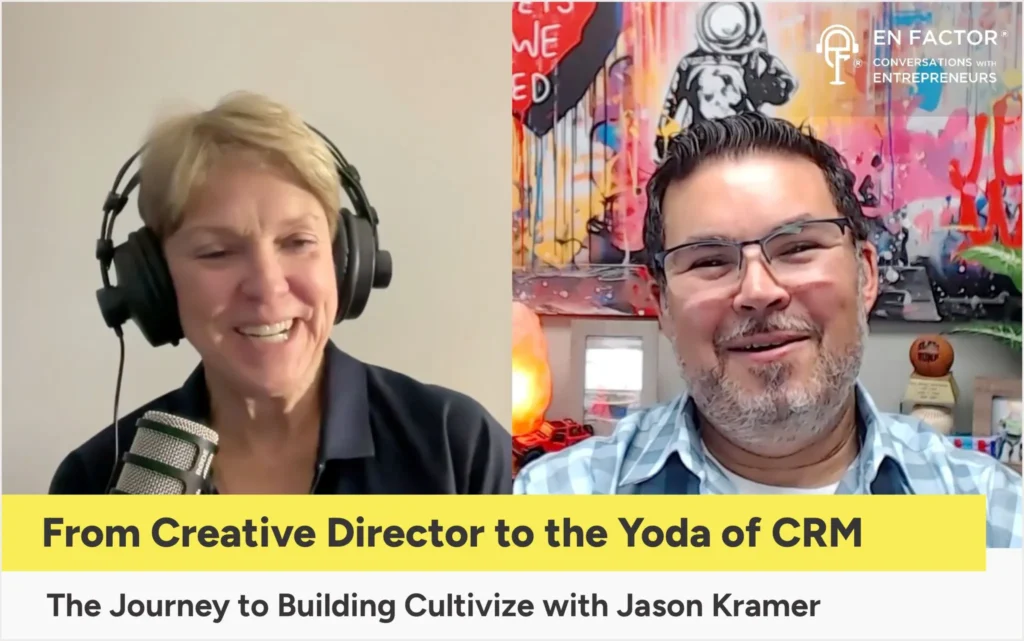
In the most recent episode of the En Factor podcast, I expected to talk with Jason Kramer, the “Yoda of CRM” and founder of Cultivize, about customer relationship management systems. What I got instead was a mirror held up to every growth challenge I’ve faced as an entrepreneur.
The Paradox Every Busy Entrepreneur Faces
Here’s what I hear from entrepreneurs constantly: they are too busy to build structure.
They operate with urgency. They are doing something new, something they haven’t done before. Startups have no history. Unless you come from the industry or have deep work experience in that context, you are figuring it out as you go, without a deep resource base.
Structure and process feel like luxuries you can’t afford because you have to focus on production.
But here’s the truth I’ve learned through my own ventures: structure is not the luxury. Chaos is the luxury you cannot afford.
The Three-Person Tipping Point
In every entrepreneurial venture I’ve launched, the pattern repeats itself.
When it’s just me, I know what needs to happen. When I bring on my number one hire, that person becomes so integrated into the system that structure isn’t critical. We operate almost telepathically.
Then comes hire number three, number four, and so on.
Suddenly we need process and structure to stay focused and move forward. Without it, we are on top of each other. Our work isn’t synchronized and we cannot use our time in the highest and best way.
Jason confirmed this pattern. He talked about overhead and agility, about building a team of six contractors who work as smoothly as a team of 50 could. But that only works because of the systems underneath.
Why Growth Triggers Crisis
I keep coming back to Larry Greiner’s model from that Harvard Business Review article I read in graduate school: “Evolution and Revolution As Organizations Grow.”
The framework explains something most entrepreneurs discover the hard way. Strategy and structure are always related. When you change or expand strategy, which you must do as organizations scale, you have to consider structure as well.
The very structure (or lack of it) and systems that work in the entrepreneurial stage often undermine your ability to succeed in the next stage of growth.
What got you here won’t get you there. This isn’t just a saying. It’s a warning.
Three Triggers That Demand Structure
During my conversation with Jason, I realized there are three clear signals that you need to stop and build systems:
Big opportunity: When market conditions shift or new legislation opens doors, you have to consider where you are headed, not just where you are now.
Expanding strategy: The moment you add a new product line, service offering, or market segment, your old systems break.
Adding people: This is the most common trigger, and the one entrepreneurs handle worst.
The Hiring Trap Nobody Talks About
We hire someone to take work off our plate.
Then we discover we have to create systems to ensure they can bring value and succeed in their new role. That takes time that we do not feel we have, and takes time away from doing the work we are good at.
This is the transition everyone talks about: working on the business instead of in the business.
And it’s really hard.
Letting go of control and trusting others goes against every instinct that made you successful as an entrepreneur. Systems and structure get you closer to replicating the way you want work performed. But entrepreneurs are notorious for needing control.
When Micromanagement Makes Sense
Here’s something controversial that Jason and I discussed: control is necessary in the earliest days of an organization. Even micromanagement.
Most leadership advice tells you never to micromanage. But there’s a season for it.
Your first hire, maybe even your second, operates almost like a partner in the startup stage. You’re building the plane while flying it together.
Once you have three or more people, you need to examine how much control you can release. This is where micromanagement becomes toxic and can kill your business instead of building it.
The Leadership vs Management Distinction
I don’t manage. If I hire someone I have to manage, I’m not happy.
I want to lead.
But here’s what I’m learning right now with my podcast team: leadership without systems isn’t leadership. It’s chaos with good intentions.
Leadership means I clarify the vision and strategy so my team can do their jobs. I add priorities from the top. This is when systems and structure become critical.
Management means people feel they have to come to me for direction constantly. I’m in control of how they do their job.
What my team needs now is clarity about what is most important. Then they need to codify the processes and systems for their work so we don’t have to constantly meet to check in.
The Power of Collaborative Structure
When Jason described CRM systems and dashboards, he was describing something bigger than software.
He was describing systems that become the clarity. Systems where people do not constantly ask “what should I do next?” because the answer lives in the structure itself.
Systems and structure created collaboratively are the most powerful. This is not about top-down control. It is about building the infrastructure together.
What Solo Entrepreneurs Need to Know
My En Factor audience includes many solo entrepreneurs. People in transition, figuring out their next move.
If you don’t have a team yet, you might think structure is premature.
You would be wrong.
Structure and systems are the only way a solo entrepreneur can consider any kind of scale.
For solo entrepreneurs, structure is not about managing other people. It is about creating the capacity to scale at all.
What should you build first? That depends on your business. But I’d focus on two areas: marketing and production.
For a solo services entrepreneur, it can mean turning the service into a “product.” For a product person, it is about using technology to be more efficient at production. For both, it is about using technology to understand and reach your market.
The Technology Foundation
Jason’s journey from creative director to CRM expert taught him something important. The right technology doesn’t complicate your business. It simplifies it.
He talked about clients who spent 20 years making customers download PDFs, print them, scan or fax them back. Think about the friction in that process. How many potential customers just walked away?
When they digitized their agreements, customers could fill out a form electronically and get a contract via email within 10 seconds.
That’s not just efficiency. That’s removing the barriers between you and revenue.
The Dashboard You’re Missing
One insight from Jason stuck with me.
Even he, someone who builds systems for a living, realized he lacked a real-time executive dashboard of his business. If you asked him about leads, conversion rates, profitability compared to last month, he would have to dig through multiple tools.
He doesn’t have time for that. So he often doesn’t look as often as he should.
Now he’s building a visual dashboard that brings in QuickBooks data, marketing data, CRM data. Everything in one place, easily accessible.
This is what structure looks like in practice. Information you need, when you need it, without hunting.
What I’m Learning Right Now
I’m in the middle of this challenge with my podcast team.
We have miscommunication, lack clarity on team roles, and spend more time in meetings than any of us want when we’re all so busy.
These are the symptoms of missing structure.
I know what needs to happen. I need to provide clearer priorities from the top and the team needs to codify their processes. We need systems that let us work asynchronously instead of constantly meeting.
But knowing and doing are different things.
The disconnect happens because I am focused on chasing opportunities. That is good, but it also means I’m adding people, expanding workflows, making changes. When you change one variable, you have to review the system and structure that supports it.
Having good customer data is powerful. It helps you address what’s needed to ensure success with new opportunities. But it’s not intuitive to put time into structure and systems when you’re in growth mode.
The Freedom Structure Provides
Jason told me about the first time he went on vacation and did not check email once.
He knew his team was taking care of everything because he had processes in place. Nobody needed to check in with him.
That’s the ultimate goal for every entrepreneur. Building a company that can run without you. Walking away for a month or two and knowing the business will be okay.
That only happens with structure.
Structure isn’t the thing that traps you. Structure is the thing that sets you free.
Where to Start
If you’re feeling the friction I described with miscommunication, the lack of clarity, and too-many-meetings problem, you are at the tipping point.
Start with one system. Not everything at once.
Maybe it’s a project management tool that tracks who’s doing what. Maybe it’s a simple CRM that captures customer information so it’s not living in your head. Maybe it’s documenting your core process so someone else can replicate it.
Pick one and build it collaboratively with your team. Make it simple enough that people will actually use it.
Structure isn’t built in a day, but rather in small, consistent steps that compound over time.
I’m learning this lesson again right now, and I’m reminded that the entrepreneurial journey isn’t linear. You do not solve these problems once and move on. You solve them at each new stage of growth.
The question isn’t whether you’ll need structure. The question is whether you’ll build it proactively or wait until the pain forces your hand.
I’m choosing proactive this time. I hope you will too.
Note: A first draft of this article was written using AI.