
I’ve spent three decades studying what separates entrepreneurs who succeed from those who don’t.
The gap isn’t intelligence, it’s not work ethic, and it’s not even opportunity. The gap is something more fundamental, more psychological, and far more uncomfortable to confront.
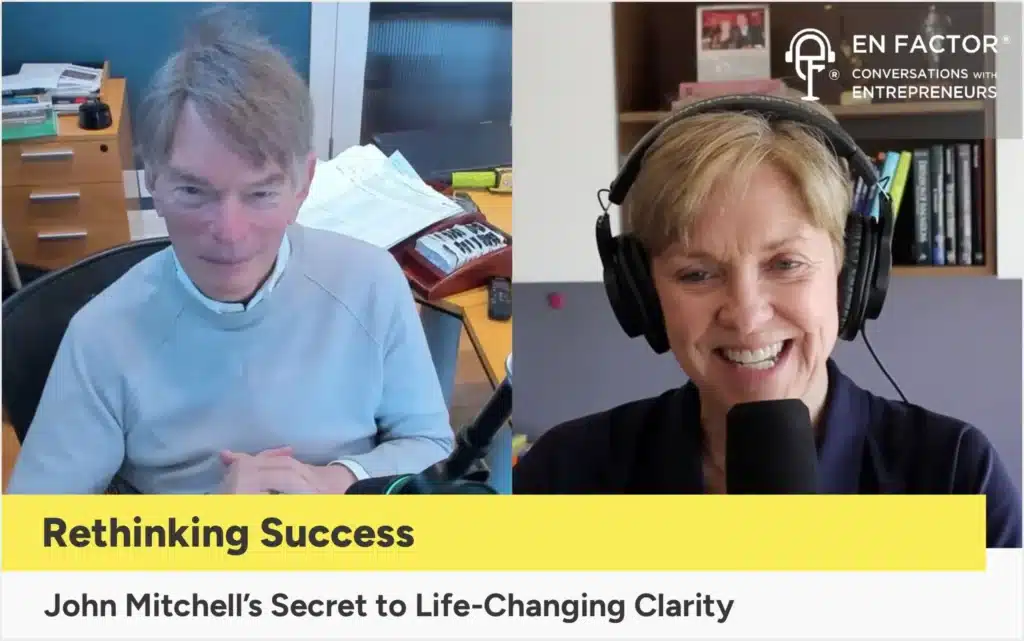
When John Mitchell appeared on the En Factor podcast, he brought a methodology that sounds almost too simple to work: spend 12 minutes each day feeding clarity to your subconscious mind through detailed visualization with emotion.
The results he describes are dramatic, income multiplying by 25 times, finding life partners, gaining unprecedented control over daily actions.
When John took his methodology to Darren Hardy, one of the world’s leading experts on success, he told him something that caught my attention: “People aren’t going to spend 12 minutes a day on this.” Not because it doesn’t work, but because for 98% of people, success is merely a preference, not a necessity.
That distinction, preference versus necessity, is where the real investigation begins.
The 95% Problem Nobody Wants to Face
John’s methodology rests on a scientific reality that most people intellectually understand but never truly grasp: 95% of our daily actions are unconscious. We are conscious of only about 5% of our cognitive activity.
Think about what that means.
Your intelligence, your education, your strategic thinking, all of that operates in the 5% zone.
The other 95% runs on autopilot, controlled by patterns programmed into your subconscious mind through years of repetition. You don’t control the very thing that determines your success: your daily actions.
I used to think hard work was the answer. Show up, put in the hours, outwork everyone else. That’s what I did for years. But John’s insight cuts through that belief. For the kind of transformational success we’re talking about, you have to work smart.
And working smart means gaining control over those unconscious daily actions.
The entrepreneurs I work with get stuck at inflection points because the patterns that got them here stop working. Micromanaging works in early stages when you’re building everything yourself, but those same patterns become the ceiling when you try to scale. The problem isn’t that they can’t see this. The problem is that their success makes those patterns feel trustworthy, even when they’re failing.
The Mechanics of Reprogramming
This 12-minute practice isn’t meditation or positive thinking. It is a specific process of feeding clarity to your subconscious mind through repetition with emotion.
Here’s how it works: you create immense clarity about your life: exactly the person you want to be, exactly what you want to accomplish, and precisely how you’re going to achieve your clearly defined goals. You put that clarity on a template. Then you feed that template to yourself every day for 12 minutes.
After 21 days, something shifts. The right actions start happening automatically.
The power is in the pause. That’s the phrase that kept coming up in my conversation with John’s methodology. We make decisions unconsciously all day long because we react to circumstances and operate on assumptions we formed years ago that may no longer hold. The 12-minute practice forces you to step out of that unconscious flow and consciously examine your decisions, your assumptions, your patterns.
You’re not just becoming aware. You’re training a muscle. You’re reprogramming what your brain notices and prioritizes.
Why 12 Minutes Feels Impossible
Here’s the resistance paradox: intelligent, capable people who spend hours sitting in unproductive meetings, trying to get through an endless to dolist or watching screens claim they don’t have 12 minutes for a practice that could transform their lives.
The surface explanation is busyness. Entrepreneurs are focused on urgent items rather than important ones. They’re in survival mode. Single parents juggling careers, founders doing everything in early stages, professionals managing constant demands. I get it because I have been there.
But that’s not the real resistance.
The real resistance is that people don’t understand how this works. They don’t grasp that it’s like working out, you’re training a muscle. Society reinforces the belief that you have to be busy all the time, that constant motion equals progress. The idea of pausing for 12 minutes feels counterproductive when you’re drowning in tasks.
You have to commit to the practice long enough to see results before it starts feeling necessary rather than optional. It’s the same reason people quit the gym by week three in January. They treat it as a preference, not a necessity. And preferences get abandoned when they become inconvenient.
The Necessity Question
This is where the investigation gets uncomfortable. What creates the internal state where failure genuinely isn’t an option? What separates the 2% who make success a necessity from the 98% who treat it as a preference?
I’ve seen entrepreneurs for whom failure simply wasn’t an option for a wide variety of reasons. That kind of commitment, where failure is not an option, makes all the difference. But what are those reasons?
I don’t think it’s desperation alone. Plenty of desperate people never commit. I don’t think it’s ambition alone. Plenty of ambitious people never follow through. There’s something deeper, something about how you define yourself in relation to your goals.
John’s story offers a clue. At 50, he wasn’t just feeling unsuccessful. He was feeling like he was letting his mother down. As she was dying of pancreatic cancer, he sat with the reality that despite all the advantages she’d given him, all he had to show for his life was average. That intense feeling became rocket fuel, driving him deeper into Think and Grow Rich than anyone else had gone.
The necessity came from identity, not just desire. It wasn’t “I want to be successful.” It was “I cannot be the person who wasted these advantages.”
When you truly make success a necessity rather than a preference, the 12 minutes becomes non-negotiable. You begin to see the power in it, just like you see results from a workout. But the hardest part is staying with it long enough to see those results. And once you start getting success, it does become more of a necessity than a preference.
Beyond Financial Success
The methodology John developed isn’t just about money. It’s about playing the game of life at your full potential. It’s about relationships, fulfillment, transformative change.
When impatience bubbles up, an unconscious thought surfaces: “Here is an opportunity to be patient.” His conscious mind takes control of that action instead of his autopilot. He moves from having his actions controlled by unconscious patterns to having his intelligence and intellect controlling his actions.
This is happening across all the different areas he’s affirming in his template. He’s playing the game of life at a higher level because he’s gained control over the unconscious 95%.
The Mirror We Need
Something or someone holds a mirror up to us when we’re facing major change. Sometimes it’s a lost customer, a departing employee, a challenge that forces us to step back. Sometimes it’s a coach, a mentor, a trusted advisor. Sometimes it’s a circumstance that opens our eyes.
But the 12-minute practice creates its own mirror. It builds self-awareness through ritual. It forces you to slow down, stop, and evaluate your decisions. It makes you ask: how did the decisions I made up to this point lead to this? What role did I play? How can I learn from this?
The practice gives you agency. It reinforces the belief that the decisions you make, the choices you make, influence the outcome. That belief, that you have control and that your actions matter, is what creates the sense of empowerment that makes the practice stick.
We are in this together, trying to figure out how to build lives that reflect our potential. The resistance to 12 minutes isn’t about time. It’s about whether we’ve truly made success a necessity or whether we’re still treating it as a preference we’ll get to when things calm down.
Things never calm down.
The question isn’t whether you have 12 minutes. The question is whether you’re willing to examine what you’re protecting by not using them.