
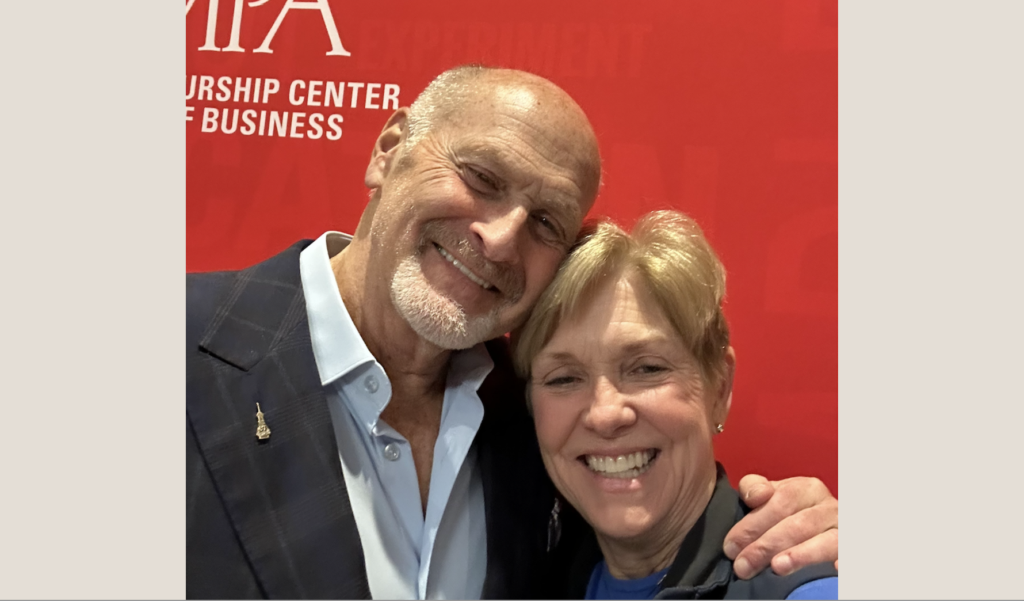
About six years ago, Benson Riseman joined me as a guest on The En Factor podcast. His insights on entrepreneurship and resilience resonated deeply with listeners, but I kept wondering: what’s changed in his journey since then? What new insights has he gained?
So I reached out to Benson for a follow-up conversation. He co-founded Green Dot, the world’s largest prepaid debit card company, and his wisdom extends far beyond financial services. What he shared with me revealed not just new perspectives, but a deeper understanding of the timeless principles that guide entrepreneurial success.
Sometimes the most valuable lessons aren’t the ones that hit you immediately—they’re the ones that reveal themselves as the business landscape evolves around them.
The Three Truths That Matter More Now
In our original conversation, Benson shared three fundamental business truths he’d learned: things always cost more than you expect, take longer than you anticipate, and turn out differently than you planned.
When asked how these principles have evolved since we last spoke, his response was striking. These truths haven’t just remained relevant—they’ve become even more critical in today’s environment.
“I think that’s more accurate now than it ever has been,” he said. “What’s accelerated everything is the expectations that we have, that business has, that society has—that everything has to happen now, that we have a magic formula that tells us exactly how much things cost, exactly how long they take and exactly what it is that will be.”
But life doesn’t work that way. Competition, weather, production, and supplies are factors that affect each of those three areas.
The accelerated pace hasn’t changed the fundamentals. It’s changed our expectations. And that gap between expectation and reality? That’s where entrepreneurs either break or build resilience.
Common Sense in an Age of Optimization
When I asked Benson how he navigated the tension between expectations and reality, his answer surprised me: “Common sense.”
In a world obsessed with data, algorithms, and AI-driven decision-making, common sense feels almost revolutionary. But he wasn’t dismissing analysis.
“Sometimes you look at something, you look at a formula, and it gives you the answer, but it doesn’t quite feel right,” he explained. “I think now more so than ever where everything is very specific, where we’re into production efficiency, time bound, dollar bound, the need and importance and pressures that we put on ourselves to be accurate really can affect the decisions we make, and that might cause us to make maybe not the best decisions.”
This is where common sense comes into play: “When you look at something and say, why or why not?”
From that answer, it creates a conversation that gets you thinking deeper into some of the real life details, giving you new insights.
Not on a spreadsheet. Not on AI. Not in formulas. But thinking about what factors you might have to consider, what things could happen that you’re not aware of, and how you want to prepare for that.
Cultivating Your Internal Compass
Benson acknowledged the complexity on how entrepreneurs develop this kind of judgment—that ability to sense when something doesn’t feel right despite what the data suggests.
He shared that “A lot of it’s trial and error. A lot of it’s just being aware of your environment. A lot of it is having people around you that can listen and guide.”
He believes we all have an internal compass that tells us when we believe something is right or wrong, when we’re leaning one way or the other.
Benson also shared that he thinks it is healthy to give yourself the leeway and freedom to think creatively. This way, you can dig into a concept and idea to come out with a well thought through answer.
Then he brought up something crucial: integrity.
“Oftentimes, especially in the startup business, you’re faced with options, questions, and decisions to make where you have an angel on one shoulder and a devil on the other. And you’re trying to wrestle with the two and trust your instincts, your intuition, and your moral compass telling you what you think is right or wrong. It might be a great thing to consider in finalizing that decision and you waking up or sleeping well and waking up happy.”
Failure as a Learned Skill
Something that Benson had shared in our original conversation was his distinction between true failure and experiences that didn’t go as planned but opened new doors. I wanted to know how his perspective had evolved.
“There were many examples,” he said. “One in particular is a client that we had in the early days that when we first tried to close them, when we presented our product, when we presented our company initially, we actually weren’t ready to fulfill what we were talking about. Them saying no actually caused us to go back and think deep, prepare more, do our own homework, find out more about their company, dig deeper and deeper into it and customize our response and customize our results and customize directly for that particular client.”
Then he said something that really struck me.
“But that happens all the time in every way. I also believe that failure is a learned skill. It’s not something to be ashamed of. Failure is something to lean into and feel good about. Not the fact that things didn’t turn out the way you thought. But you’re closer to finding out the way things could be, should be, or you want them to be. And trial and error is a good way to do that.”
The challenge, he explained, is minimizing trial and error within a reasonable timeline “so that we make good decisions in a reasonable basis, but yet they’re good decisions that we can feel proud of.”
Failure isn’t something to avoid. It’s feedback that moves you closer to the right solution.
The Danger of Proving Yourself Right
One of the most powerful lessons from Green Dot’s journey came up when Benson talked about recognizing when to pivot your business model. His answer reveals a trap that many entrepreneurs fall into.
“You know, when you do your research, you can prove yourself right one hundred percentage of the time. And that doesn’t mean that you are.”
He explained how Green Dot initially started as a prepaid card for youth, so parents could empower their children with financial responsibility.” All of the follow up they did was to prove that fact.
But over time, they realized it wasn’t youth buying the products—it was their parents. At first, they explained this way: of course parents are buying it, it’s a youth product.
“What we then came out to learn only by listening hard, talking amongst ourselves and the company, seeing who the purchaser of the product were, and then going back and continuing to have a conversation with our customers, that our core customer was the unbanked and the credit challenged.”
Some happened to have children. Some gave their children the cards. But the real customers were single moms or dads who couldn’t put a five dollar bill through a hard drive and wanted to rent a car or take their kids to Disney World without a credit card.
“The work that we did was being aware, by looking in the mirror and saying to ourselves, are we trying to prove what we think or are we trying to get to the true answer?”
This is intellectual honesty at its core.
But if you’re listening through your own ears and your own head to find support for an answer you’re looking for? “You might get that answer and you’ll be able to justify it, but that doesn’t mean that that’s what’s going to work for your business.”
Reading the Signals
How do you know when you need to reconsider your fundamental assumptions? Benson’s advice is practical.
“A lot of it comes with just pitching your product and talking to your neighbors and friends. If they keep bringing up the same objections or they keep bringing up the same questions, then you have to ask yourself, am I really positioning my product and selling its benefits? Am I really creating the word pictures I need to so that they truly understand what it is that I’m providing them?”
“A lot of times that doesn’t happen.”
Recurring objections aren’t obstacles. They’re market intelligence. They’re telling you something important about how your message is landing—or not landing.
Where Resilience Really Comes From
I wanted to understand what mental frameworks helped Benson push through the inevitable low points of entrepreneurship. His childhood came up—growing up with limited resources, watching his mother who couldn’t read or write still manage to survive and provide.
He was thoughtful on how those experiences shaped his resilience:
“I think it’s survival. I mean, you don’t really think of it as survival. Through my lens, that’s the way life was.”
Because he didn’t have a lot, because not a lot was provided, because he didn’t have resources, he naturally decided: “If I want these things, I have to figure out how to get them and then you go to work and figure that out.”
He learned to figure out the questions to ask and who to talk to. He understood that by not expressing yourself or not asking questions, you don’t get the answers you need to move forward.
Although it sounds intense, survival is what it was: learning to navigate what’s in front of you with whatever resources you have.
When I asked about Green Dot’s difficult moments, including times when funding seemed impossible, Benson shared what kept them going.
“I think that myself and my partner, we recognized that we were onto something because every time we had a pitch, every time we spoke to somebody new, they weren’t ready to buy, but it created quite a conversation. There was interest in the product, there was interest in what we provided, and they wanted to know if we could deliver that.”
That ability to distinguish between rejection and genuine curiosity kept them moving forward when others might have quit.
Scaling Through Belief and Solutions
As he talked about Green Dot’s transformation from startup to publicly traded company, Benson brought up the leadership principles that became most essential during scaling.
“Well, belief is a big one,” he said immediately. “It’s hard when you’re creating something new to get everybody to look through the same lens, but that’s how you enroll people in your vision, your energy, your excitement, your effort, your dedication, and your commitment. I think leading by example is crucial for people knowing that you care. You know you believe, and you’re leading the march. Gives them reason to line up behind you and continue forward. And that’s really a powerful effort.”
But belief alone isn’t enough. Creativity matters.
“Creativity is very important. What’s worked for our company was there’s always questions, but also the belief that there’s one hundred percentage of the time a solution. It might be a challenging solution, it might not be a solution you feel as comfortable with, but there’s always a solution to whatever question or problem arises.”
The challenge becomes: “How do we continue to make that better? How do we continue to make that solution even better? Can we perfect it? Can we ask more questions? Can we fine tune? Can we run it by them and get their feedback?”
This mindset creates a culture where obstacles become puzzles to solve rather than reasons to stop. There’s always a path forward—it’s just a matter of finding it and refining it.
The Anchors That Hold
Near the end of the conversation, Benson shared what advice he’d give to entrepreneurs today who are facing increasing uncertainty in the business landscape.
“Be authentic, have integrity.”
These play a huge role in building a sustainable business as our world is increasingly connected and transparency is higher than ever before.
In a business environment that’s constantly shifting, where expectations are unrealistic and the pressure for immediate results is intense, authenticity and integrity are anchors that hold you steady.
They’re the foundation that doesn’t change even when your strategy, your market, or your entire business model does.
What I’m Taking Forward
Following up with Benson reminded me that entrepreneurial wisdom isn’t always about new insights. Sometimes it’s about recognizing how timeless principles become even more relevant as the landscape shifts around them.
His three business truths matter more now because our expectations have become unrealistic. His emphasis on common sense matters more because we’re drowning in data and optimization. His perspective on failure as a learned skill matters more because the pressure to succeed immediately has never been higher.
And his warning about proving yourself right? That matters because we’re all susceptible to researching for confirmation rather than truth.
The entrepreneurs who succeed aren’t the ones with perfect plans or magic formulas. They’re the ones who expect things to cost more, take longer, and turn out differently—and who see that not as failure, but as the natural path to finding what actually works.
They balance analysis with common sense. They cultivate their internal compass through trial and error. They lean into failure as feedback that moves them closer to the right solution. They listen to discover rather than to confirm.
And they lead with authenticity and integrity as anchors when everything else shifts.
These aren’t revolutionary ideas. But that’s exactly why they work. The fundamentals don’t change. We just need to keep remembering them—and recognizing how they apply to the unique challenges of our moment.
Note: A first draft of this article was written using AI.