
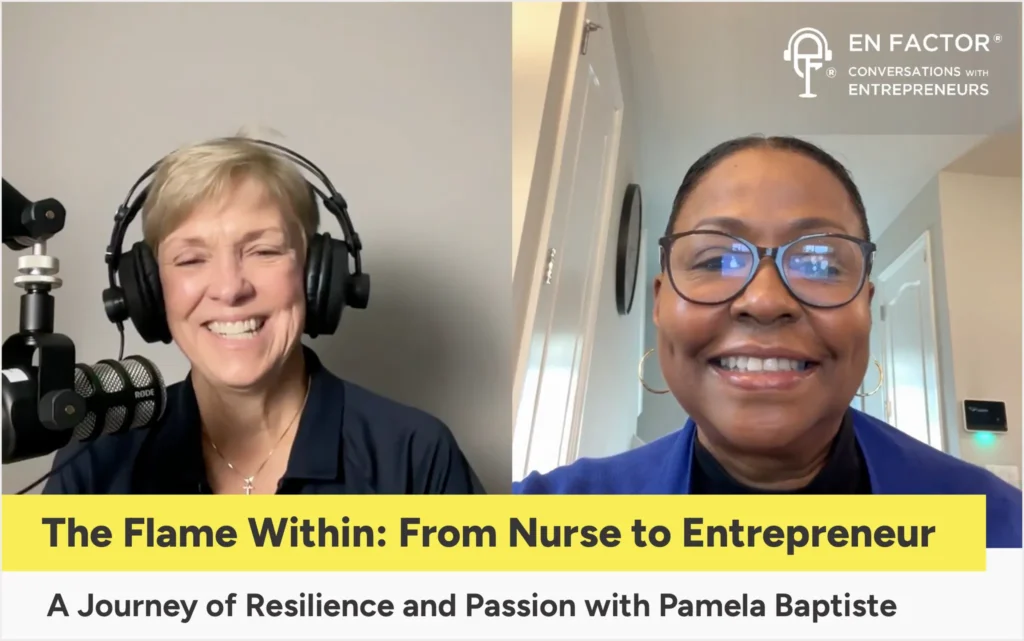
I knew Pamela Baptiste’s story would resonate with my listeners the moment she started talking about her childhood in Trinidad.
Not because it was exotic or unusual.
Because it was foundational.
She grew up watching her parents run a small business selling homegrown vegetables and poultry to their neighborhood. Nothing fancy, just resourcefulness, hard work, and service to community. The kind of entrepreneurship that doesn’t make headlines but builds character.
That early exposure to bootstrapping created something in Pamela that would carry her through immigration, nursing school, years in bone marrow transplantation at Memorial Sloan Kettering and Moffitt Cancer Center, and eventually to authorship.
What struck me most wasn’t any single achievement.
It was how she stayed true to herself and her purpose across dramatically different contexts.
The See, Do, Repeat Model in Real Life
I talk about the See, Do, Repeat model constantly on my podcast. It’s the framework I developed over 20 years of studying entrepreneurial mindset.
Pamela embodied it without ever hearing the term.
She saw an opportunity to share her nursing journey in a way that would help others. Young professionals entering healthcare. People facing their own transitions. Anyone who needed to know their story mattered.
Then she did something about it. She wrote. She persevered through the challenges of bringing a book to life. She stayed focused on the end goal even when she had decades of experiences to sort through.
And she repeated that pattern of service throughout her entire career. Through every environment, every stage of life, every context shift.
The execution piece is where most of us get stuck.
So many people know what they’d like to do. They see the opportunity. They feel the pull. But they never take those first steps.
For a wide variety of reasons that all sound reasonable in the moment.
Why Healthcare Professionals Have a Unique Advantage
Here’s what I’ve learned from working with nurses and other healthcare professionals: they build a certain kind of resilience that translates directly to entrepreneurship.
They work in high-risk environments, life and death situations, with vulnerable patients facing uncertain outcomes.
This gives them perspective that most entrepreneurs lack.
Think about it. When you’ve witnessed how precious and short life is, when you understand human vulnerability at a visceral level, entrepreneurial risk looks different.
Why fear failure when you’ve seen what real loss looks like?
They’re not just treating patients anymore. They’re building businesses, creating new models of care, and addressing gaps in the healthcare system.
Pamela saw this trend clearly. She attributes it to technological advancements, innovative approaches to patient care, and the transformative impact of the pandemic.
Healthcare professionals had to practice and serve differently.
That pressure created innovation.
The Risk Paradox Nobody Talks About
Here’s the thing about risk that most people misunderstand: avoiding it doesn’t make you safer.
When you avoid risk and challenge, when that fear of failure keeps you from taking action, you actually put yourself at much higher risk. Because you don’t get the training you need to handle challenging situations.
Think about astronauts. They practice before they go into space. The military trains extensively before deployment. High-performing athletes simulate game conditions.
They don’t avoid risk. They prepare for it.
Nurses do this every day without thinking about it. They build resilience through direct experience, learn to navigate uncertainty, and they make decisions under pressure.
That’s professional training in entrepreneurship, even if nobody calls it that.
And here’s what really matters: life is going to bring challenges regardless.
You don’t get to opt out of difficulty by playing it safe. Not taking action is an action in itself. It just leads to different challenges.
Pamela understood this deeply, and she kept moving forward because staying still wasn’t actually safer.
What Immigrant Entrepreneurs Know That Others Don’t
There’s another dimension to Pamela’s story that matters.
She’s an immigrant entrepreneur. Someone who left Trinidad and built a life in the United States through sheer determination and resourcefulness.
Immigration itself is an entrepreneurial act because you’re stepping into uncertainty, adapting to survive, and building something from limited resources.
Pamela brought those values with her from Trinidad: the community focus, service orientation, and resilience her family taught her.
And she carried them through every transition.
That’s what fascinated me most about our conversation. How she stayed true to her purpose even as contexts changed dramatically around her.
From an island where community was everything to New York City where the environment was completely different. From nursing school to Memorial Sloan Kettering to Moffitt to authorship.
The flame within stayed lit.
Service as Entrepreneurial Fuel
When I asked Pamela what kept her going through difficult times, her answer was immediate.
Service to others.
That commitment to serving others became her anchor. The thing she could return to when challenges felt overwhelming.
It’s a powerful form of motivation because it’s bigger than yourself. Your patients need you. Your readers need your story. The people coming behind you need guidance. You can’t quit on them.
This is especially true in healthcare, where the work is emotionally taxing. Where you face loss and suffering regularly and burnout is a constant threat.
But that service orientation also creates entrepreneurial opportunities.
Pamela recognized she could broaden her impact beyond direct patient care because she had decades of experience. She had lessons learned through challenges and wisdom that could help aspiring healthcare professionals.
So she wrote The Flame Within.
Not because she wanted to be an author. Because she wanted to serve more people.
That’s the entrepreneurial mindset in its purest form. Seeing a need. Taking action. Persevering until you create something valuable.
The Completion Principle
One insight from our conversation stuck with me.
Pamela talked about recognizing when to bring her book project to completion. She had many years of experiences to draw from. She could have kept writing indefinitely.
But she also recognized the need to finish. To get it into readers’ hands.
I’m sure her nursing experience taught her this. In healthcare, you can’t endlessly deliberate. Patients need treatment. Decisions must be made. You have to stay focused on the end goal.
It’s about knowing when something is complete enough to fulfill its purpose.
Not perfect and not exhaustive. Just ready to serve.
That’s a lesson every entrepreneur needs. The willingness to put your work into the world even when you could refine it further.
Because impact requires action, not endless preparation.
What This Means for You
If you’re a healthcare professional considering an entrepreneurial path, Pamela’s story offers a roadmap.
Your clinical experience isn’t separate from your entrepreneurial potential. It’s the foundation.
The resilience you’ve built through high-pressure situations. The service orientation that drew you to healthcare. The understanding of human vulnerability and what really matters.
These are entrepreneurial advantages, not obstacles to overcome.
And if you’re facing a major life transition, whether in healthcare or any other field, remember this: challenges are coming regardless of what you choose.
The question isn’t whether you’ll face difficulty.
It’s whether you’ll face it while pursuing something meaningful or while playing it safe.
Pamela chose meaning. Service. Purpose.
She saw opportunities to help others, took action, and repeated that pattern across decades and contexts.
The flame within kept burning because she fed it with service.
That’s not just an inspiring story. It’s a practical model for anyone seeking to create impact through entrepreneurship. Listen to the En Factor episode here.
See the opportunity. Do something about it. Repeat until it becomes who you are.
Life won’t last forever, so the time to act is now.